-
Ahmedabad

- 330-338 Devnandan Mega Mall, Opp. Sanyas Ashram, Ashram Road, Ellis Bridge, Ahmedabad – 380006
- +91 88 66 88 07 07
- inquiry@aspiresquare.com
-
Surat

- 1027, 3rd Floor, West Field Shopping Complex, Near ST Xaviers School, Ghod Dod Road, Surat – 395007
- +91 95122 24365
- inquiry@aspiresquare.com
-
Vadodara

- 418, Pinnacle Plaza, Near Tulsidham Char Rasta Manjalpur, Vadodara – 390011
- +91 75730 24365
- inquiry@aspiresquare.com
-
V.V. Nagar

- 105, Sigma Complex, Above D-Mart, Nr. Sardar Patel Statue, Vallabh Vidyanagar, Gujarat 388120
- +91 95 12 99 0707
- inquiry@aspiresquare.com

Last Updated Jan 16,2026
Australia Student Visa Update 2026 – Evidence Level Changes Explained
Australia
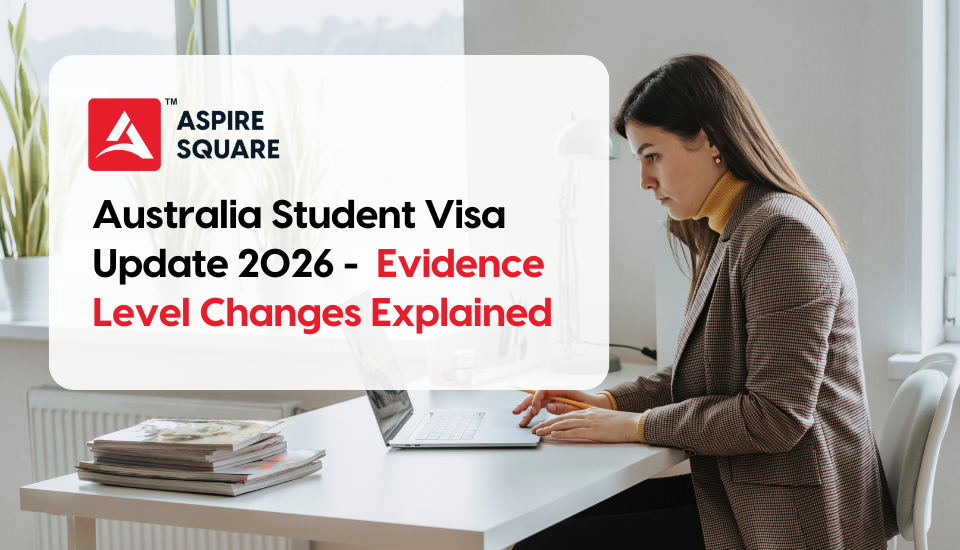
Australia’s student visa system continues to evolve, and one of the most important changes affecting applications in 2026 is the update to Evidence Levels under the Simplified Student Visa Framework. These changes directly impact how much documentation students must submit and how closely applications are assessed for compliance and risk.
This guide explains what evidence levels are, why they matter, what has changed recently, and how students should prepare their applications to avoid refusals or delays.
What Are Evidence Levels in the Australian Student Visa System?
Under the Simplified Student Visa Framework, Australia uses a risk-based assessment system known as Evidence Levels. These levels determine the amount of documentary evidence an applicant must provide when applying for a Student Visa (Subclass 500).
Evidence Levels are determined based on factors such as the applicant’s country of passport and the education provider’s compliance history. The goal is to balance visa integrity with efficient processing for genuine students.
Types of Evidence Levels
Australia broadly categorises applicants into three Evidence Levels.
Evidence Level 1 is considered low risk and generally requires minimal documentation.
Evidence Level 2 is medium risk and usually requires additional academic and financial evidence.
Evidence Level 3 is high risk and requires the most comprehensive documentation, including financial capacity, English language proficiency, and strong proof of genuine study intent.
Evidence Levels are not published as a static country list. They are applied dynamically through the official Document Checklist Tool when an application is prepared.
Why Evidence Levels Matter for Student Visa Applications
Evidence Levels influence several key aspects of a student visa application.
They determine how much financial proof is required, whether English test results must be submitted, the level of scrutiny applied by visa officers, and how long the application may take to process.
A higher Evidence Level does not mean a visa will be refused. It simply means the applicant must submit stronger and more complete documentation to demonstrate compliance.
What Changed in Evidence Levels in 2026?
In January 2026, the Department of Home Affairs implemented changes that moved several source countries into a higher Evidence Level category. As a result, student visa applications from these countries are now assessed with increased documentation requirements.
Applicants affected by this change must now submit full financial evidence, English language test results, and more detailed academic documentation at the time of application.
These changes were introduced to strengthen visa integrity and reduce non-genuine applications, not to restrict access for genuine students.
What Evidence Level 3 Means for Applicants
Applicants assessed under Evidence Level 3 are generally expected to provide complete financial documentation, proof of English proficiency, academic transcripts, qualification certificates, and a well-structured Genuine Student statement.
Applications are examined more carefully, but approval is still achievable with correct preparation and transparency.
How Australia Determines Evidence Levels
Evidence Levels are determined using internal risk indicators such as visa refusal rates, compliance trends, and provider performance. These indicators are reviewed regularly, meaning Evidence Levels can change over time.
Applicants should always rely on the official Document Checklist Tool to understand their exact requirements rather than assuming eligibility based on previous rules.
Typical Documentation Expectations by Evidence Level
Applicants at lower Evidence Levels may submit basic documents, while higher levels require detailed financial statements, English test scores, academic progression evidence, and a strong Genuine Student explanation.
The exact list of required documents depends on the individual profile and education provider and is confirmed through the checklist tool.
Impact on Student Visa Applications
The 2026 Evidence Level updates mean applicants must prepare stronger and more complete applications. Students should expect closer scrutiny of financial capacity, course relevance, and long-term study plans.
These changes reflect Australia’s broader immigration focus on compliance and quality outcomes rather than reducing student intake.
How to Prepare a Strong Student Visa Application
Applicants should always use the official Document Checklist Tool before submitting an application. Financial documents should be clear, consistent, and sufficient to cover tuition and living costs.
English test results should be valid and submitted where required. Academic history must demonstrate logical progression, and the Genuine Student statement should clearly explain course choice, career goals, and study intentions.
Common Misunderstandings About Evidence Levels
Many applicants believe that being placed in a higher Evidence Level guarantees refusal. This is incorrect. Evidence Levels only affect documentation requirements, not the final decision.
Another misconception is that Evidence Levels are fixed. In reality, they are reviewed and updated periodically based on risk trends.
Conclusion
Evidence Levels are now a central part of Australia’s student visa assessment process in 2026. While recent changes have increased documentation requirements for some applicants, genuine students with complete and well-prepared applications continue to receive approvals.
Understanding Evidence Levels, using the correct tools, and submitting transparent documentation are the keys to navigating the updated student visa framework successfully.
Latest News